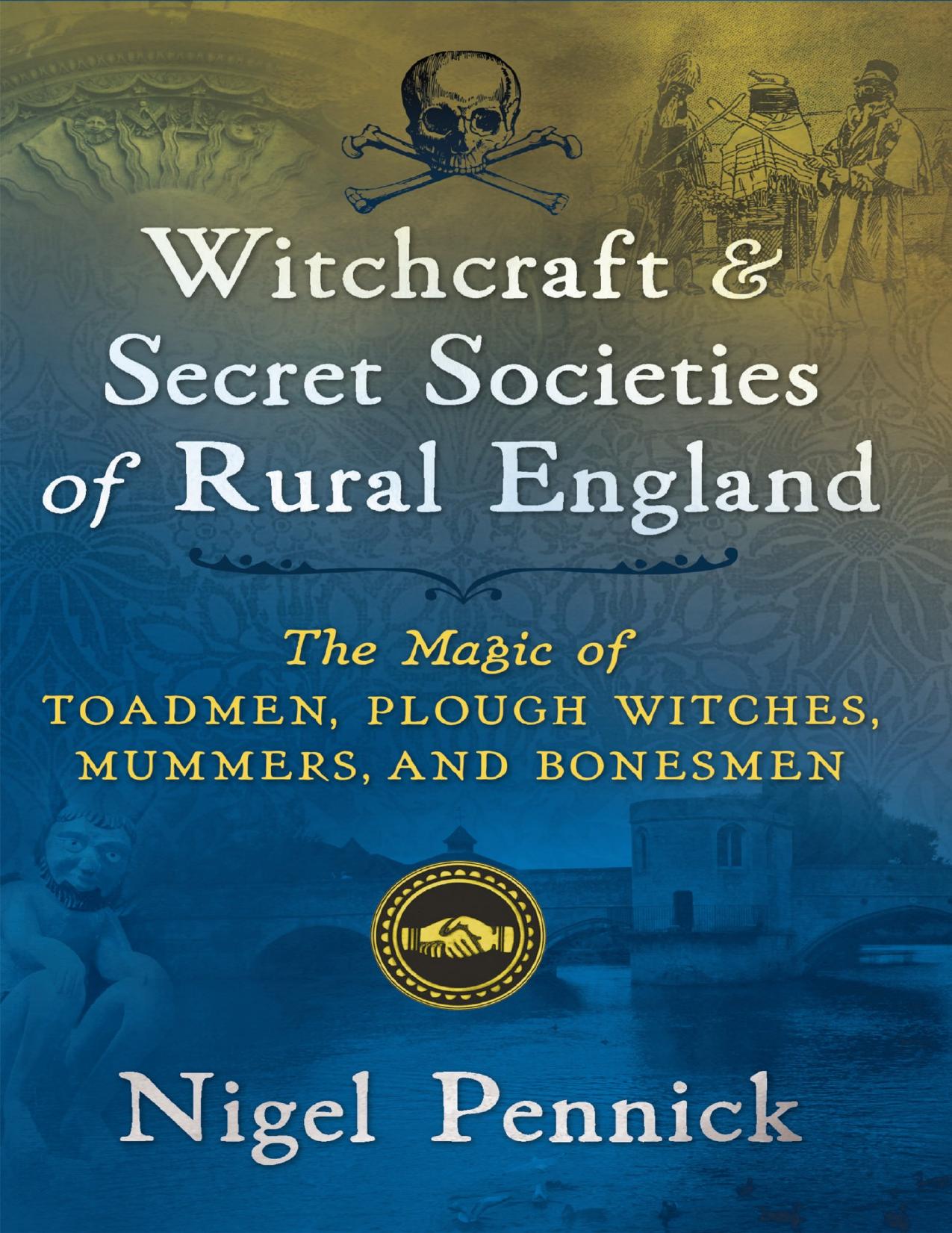
Witchcraft and Secret Societies of Rural England by Nigel Pennick
Author:Nigel Pennick
Language: eng
Format: epub, pdf
Tags: Spirituality/Occult
Publisher: Inner Traditions/Bear & Company
Published: 2019-02-18T16:00:00+00:00
Fig. 8.1. Masked highwaymen robbing travelers, eighteenth century.
The starving farm laborers who took part in the Ely and Littleport riots of 1816 wore disguises. Militant workers in various parts of Britain have used the same forms of disguise during demonstrations and in their attempts to enforce solidarity during strikes. In the early nineteenth century in South Wales, strikers disguised themselves when they intimidated strikebreakers. The disguises they wore included blackened faces or masks, reversed jackets, cowhides, and women’s clothing, items recognizable from the Plough Monday tradition. The Scotch Cattle traveled about as a “herd” of up to three hundred men, led by a “bull.” Frequently, they were “flying pickets,” men who came from a nearby town, so that the victims had less chance of identifying the members of the herd.
As they surrounded the cottage of a strikebreaker, in miner’s strikes called a “blackleg,” the members of the herd shouted, rattled chains, and blew cow horns. Usually, they then smashed windows and battered down the door, tore up sheets, curtains, and clothes, and smashed the furniture of the blackleg miner. If the butt of the attack resisted, he was given a heavy beating. In 1834, a miner’s wife was murdered in an attack of the Scotch Cattle, leading to the execution of two of the perpetrators. Scotch Cattle also looted truck shops,*6 which claimed the monopoly of miners’ supplies (Evans 1961, 48–51). The Scotch Cattle may have originated around 1808; by 1822, they came to the notice of those who wrote about such things, and the last recorded instance in the nineteenth century was in 1850. During the General Strike of 1926, some pickets in South Wales appeared as Scotch Cattle (Francis 1976, 232–60). The parallel with the plough bullocks of Plough Monday in eastern England is striking.
In the winter of 1830 and 1831, farm laborers in southern England organized themselves into gangs to try to alleviate the harsh working conditions they were forced to endure. The rural followers of Captain Swing emulated the urban Luddites in destroying the machines that were taking away their work and rendering them destitute. Captain Swing’s targets were the threshing machines. As well as campaigning for increased wages and better provisions for the poor, those under Captain Swing’s banner sought justice from those who had oppressed them. They were known as “rural incendiarists” because their favored direct action was burning hayricks. Sometimes, though, they made direct attacks on the houses of the landowners and local landlords when they demanded food, drink, and money from their victims. Captain Swing, the generic insurrectionary name, like Jack Straw five hundred years before, sent letters threatening to burn down the barns and the “Blackguard Enemies of the People” within them. The movement was suppressed with maximum force: six hundred were imprisoned, five hundred transported to Australia, and nineteen were executed.
Download
Witchcraft and Secret Societies of Rural England by Nigel Pennick.pdf
This site does not store any files on its server. We only index and link to content provided by other sites. Please contact the content providers to delete copyright contents if any and email us, we'll remove relevant links or contents immediately.
| Ancient & Controversial Knowledge | Ghosts & Hauntings |
| Hermetism & Rosicrucianism | Magic Studies |
| Occultism | Parapsychology |
| Supernatural | UFOs |
| Unexplained Mysteries |
Animal Frequency by Melissa Alvarez(4514)
Sigil Witchery by Laura Tempest Zakroff(4300)
Real Magic by Dean Radin PhD(4173)
Fingerprints of the Gods by Graham Hancock(4050)
Aleister Crowley: The Biography by Tobias Churton(3676)
Journeys Out of the Body by Robert Monroe(3657)
Alchemy and Alchemists by C. J. S. Thompson(3557)
The Rosicrucians by Christopher McIntosh(3549)
Mysteries by Colin Wilson(3493)
The Hatha Yoga Pradipika (Translated) by Svatmarama(3419)
Hitler's Monsters by Eric Kurlander(3389)
Wicca: a guide for the solitary practitioner by Scott Cunningham(3214)
John Dee and the Empire of Angels by Jason Louv(3193)
Infinite Energy Technologies by Finley Eversole(3014)
Book of Life by Deborah Harkness(2988)
Dark Star Rising by Gary Lachman(2891)
The Book of Lies by Aleister Crowley(2876)
To Light a Sacred Flame by Silver RavenWolf(2866)
Aliens by Jim Al-Khalili(2859)
